
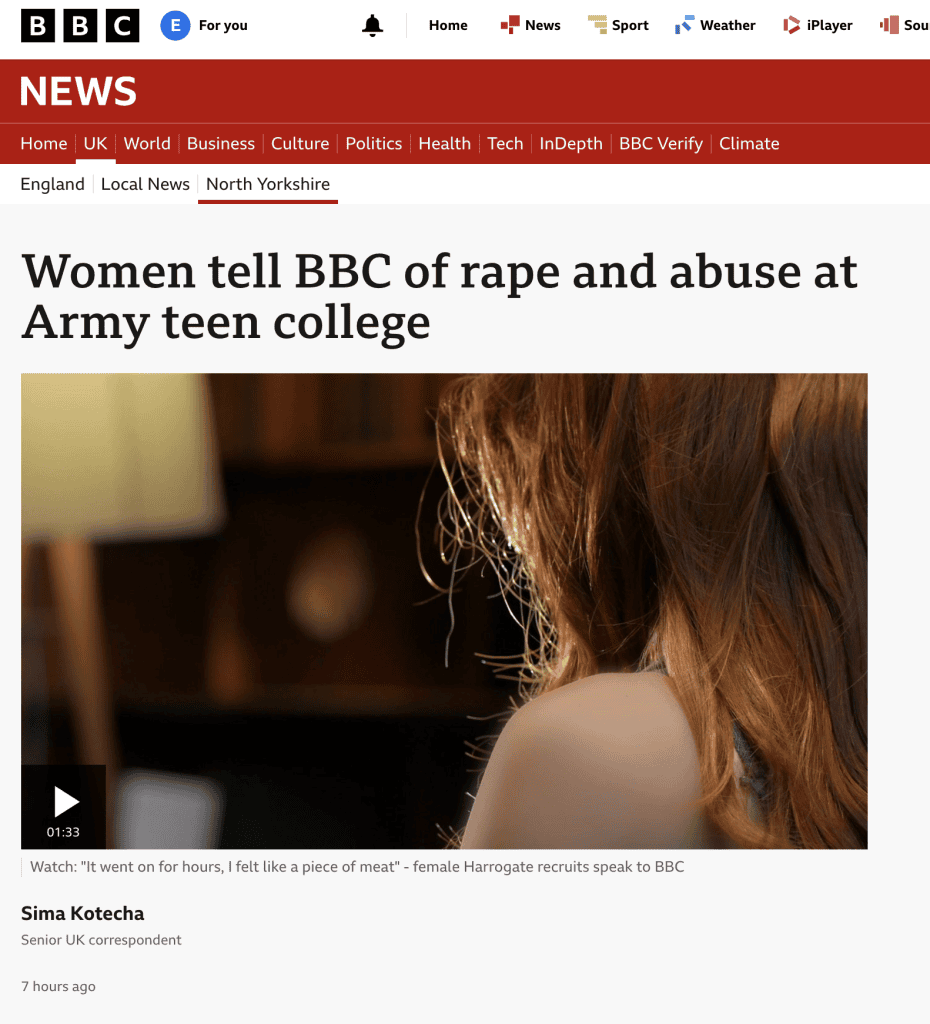
Today the BBC is reporting a number of shocking cases at the Army Foundation College in Harrogate (AFC(H)). Those young girls have been very badly let down by an institution that was supposed to train, support and protect them. They leave AFC(H) having experienced career-ending and potentially life changing abuse.
In response, MOD will highlight reforms they have introduced in recent years for tackling such behaviours and supporting victims. At the CMJ we do not underestimate those changes, nor the challenges for an institution the size of the British Army. Nor do we pretend that many of these issues are not also problems of wider society.
But we do believe that the experiences of these young women tell us much about the wider culture. The armed forces is overwhelmingly male, with women making up just 12% of the total population, and the women that seek help from us frequently report a misogynistic culture that minimises harassment or worse and does not keep women safe. We are also struck by the disparity between the official public reaction of the Army when cases like these, or cases like Jaysley Beck’s, hit the headlines, and the reality behind closed doors when these things happen in the first place and before MoD faces the full glare of the press.
That stuff matters. A Service Inquiry report, published in January this year, disclosed widespread failings in the Army’s training establishments for tackling unacceptable behaviours, and highlighted failings that, in some cases, were flagged as long ago as Deepcut. However, the initial position of the Army was that they were not going to publish it (until our client sent a strongly worded letter setting out why that was wrong (and unlawful)). That disinclination to be open and transparent is exactly the problem – and why at the CMJ we do not feel reassured by the MoD’s response today nor optimistic today that these incidents will not recur.
In 2022, CMJ represented and assisted a young woman who had experienced a sexual assault at Army Foundation College (Harrogate). Among other things, we assisted her to make a formal service complaint about multiple aspects of her experience while at the college, including the sexual assault itself, instances of sex discrimination and concerns about the wider culture. After a long delay, almost all of her complaints about the culture and alleged sex discrimination were rejected by the Army (via their internal service complaints process); and the more serious parts of her complaint were stood up into a ‘Service Inquiry’ in recognition of their seriousness, which started in April 2023. A Service Inquiry is a broader inquiry, that can be instituted by the service concerned into wider issues of concern. The young woman herself was completely excluded from that Service Inquiry but she was assured that, when the Service Inquiry reported, she would be briefed about its contents in advance and the Service Inquiry report would be published.
After a long delay and after much chasing from us, we were shocked to be told that the Inquiry had already concluded many months before and that, after all, ‘the Army decided not to publish it’.
Following further legal correspondence, expressing serious concern about this decision, the Service Inquiry was finally published on 26/01/26 (without the promised briefing to the young woman whose case had, in part, prompted its existence). The Army – for completeness – has maintained in correspondence with us that its revised decision to publish had nothing to do with the legal correspondence it received. We are not at all persuaded by that, not least because a colonel told us, in terms, that the Army had decided against publication. After we sent our letter, the report was published. People can make up their own minds.
The Service Inquiry report is highly detailed, thorough and is unlikely to have made its author(s) popular. Ironically, it is a good example of an organisation seeking to be honest with itself about the challenges it faces and the need for change which makes the original decision not to publish so disappointing. But it makes for difficult reading. There are a huge number of conclusions and recommendations, some of the key points include:
1. The organisational change recommended by the Atherton Inquiry of 2021 (on women in the armed forces) (as well as older inquiries such as the Deepcut Review) has still not been embedded within the organisation.
2. False assurances are being given by those in charge of training Junior Solders (JSs)/trainees to higher headquarters about really important issues to do with welfare and training.
3. There are issues with the instructor selection and training for instructors in the training estate with a number having to be removed from post because they are unsuitable. Of particular concern is that it was ‘nigh on impossible’ to assess which staff have completed their mandatory training for dealing with trainees/children.
4. Females are in a stark minority. While the CoC was making all the right noises about inclusivity, it seems girls were reporting not being wanted in the Army and were not confident about reporting bad behaviours.
5. Girls/women had to sort out the removal of sanitary bins from the female toilets themselves in some blocks, as this was not apparently part of the private cleaning contracts – making them feel and look like second class citizens.
6. The Supervisory Care Directive – which sets out how units are to provide care and support to staff and JSs/trainees – was poor. External auditors (like OFSTED) had failed to pick this up. Independent advisory panels who provide a layer of external oversight of the training establishments are not raising matters of tangible importance. They are never and can never be truly critical. There was a consistent thread of criticism throughout the report on the failure of the external assurance bodies to spot the failings the Service Inquiry team had found.
7. There was a problem with out of hours supervision/care for trainees/children – again, this is an issue that went all the way back to Deepcut.
8. Inadequate care and attention was paid to the educational needs of some of the JSs/trainees who struggle with literacy and will have struggled to understand and engage meaningfully with some of the initial training including around unacceptable behaviours.
9. Commanding Officers are not ensuring the relevant policies on health and welfare and vulnerability risk management are being applied correctly – this carries a ‘high degree of risk as the CO is not aware of individuals who arguably belong to their most vulnerable cohort’.
10. Signposting for trainees/JSs to access expert external assistance or support was inadequate.
14. The investigating panel were ‘repeatedly rebuffed’ by the CoC when it suggested they were far too reliant on assurances from their staff that all was in order.
15. Despite providing repeated assurances that trainees are to be told of their right to report criminal offences to the civilian police, this is not actually happening. This was an assurance that had been given to the Coroner in one of the Deepcut inquests in 2018 as a means of dissuading the Coroner from making recommendations and was still not in place.
16. A key document that sets out a step by step guide to COs on what to do after someone reports a sexual offence is buried within lots of larger policies and is very hard to find; and there was very patchy reference to the victim’s code.
18. Victims are not being included when a matter is resolved via a disciplinary process.
There is much more detail in the report. We understand that the Army has accepted the report’s recommendations.
The problem is, they accepted the Blake (Deepcut), Wigston and Atherton reviews’ recommendations too. And their first instinct, when they received this report, was not to publish.
That, right there, is the problem.